

What studies found
- Positive fantasies alone can lower energy. Kappes and Oettingen (Journal of Experimental Social Psychology, 2011) found that idealised fantasies about a goal were followed by lower energy in lab studies. Feeling as if you are already there can take the push away.
- Contrasting the wish with the obstacle helps. Oettingen's research on mental contrasting, and the WOOP method built on it (Wish, Outcome, Obstacle, Plan), pairs the picture with what is in the way and a concrete if-then plan.
- Seeing a realistic future self changed choices in a study. Hershfield and colleagues (Journal of Marketing Research, 2011) showed people realistic images of their older selves, and they chose to save more in the study. That is a narrow finding, not proof that any picture makes goals happen.
How to use a vision board the way the research suggests
- Wish: pick one goal that matters this year.
- Outcome: picture it vividly. A photo, or a short film of you in the scene.
- Obstacle: name the main thing in your way, honestly.
- Plan: write "If that obstacle shows up, then I will..."
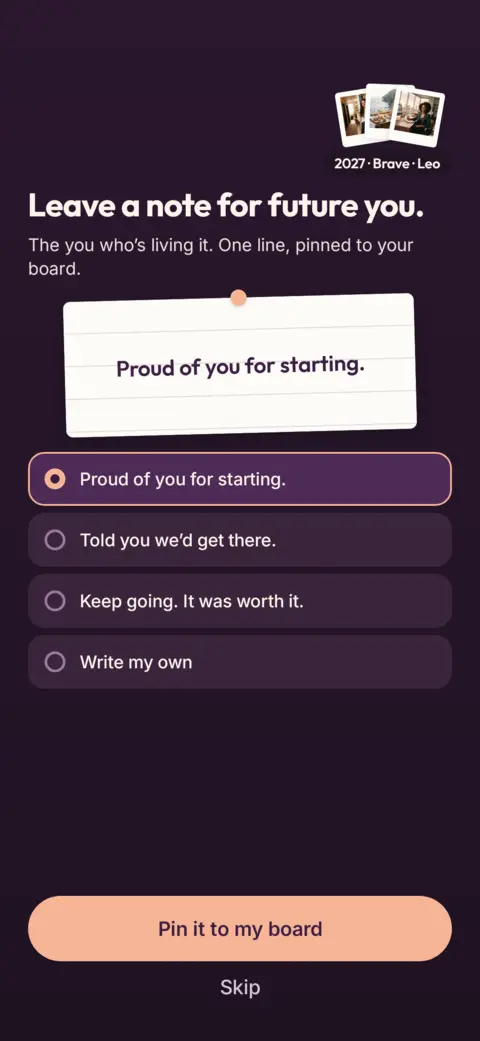
In VisionReel, your films are the outcome step and the optional note to future you is a good place for the obstacle and the plan. Watch the film, read the note, then do the next small thing.
Why a board can make you feel worse
If the board only shows the finish line, looking at it can feel like a reminder of what you do not have yet. Adding the obstacle and the next step turns it back into a plan.
Films are AI visualisations made for inspiration. They are not predictions, and they may not look exactly like you. VisionReel is for adults 18+.
Questions
Do vision boards actually work?
Not on their own. Research suggests picturing a goal works better when you also name the obstacle and make an if-then plan (mental contrasting, WOOP).
Is there science behind visualisation?
Yes, with limits. Positive fantasy alone lowered energy in lab studies (Kappes and Oettingen, 2011), while contrasting the wish with obstacles and planning helped in Oettingen's research.
Why does looking at my vision board make me feel worse?
A board that only shows the finish line can remind you of the gap. Add the main obstacle and one next step to make it a plan again.
Will seeing the video make my goal happen?
No app can promise that. The films are AI visualisations made for inspiration, not predictions. Many people use a vision board as a daily reminder of what they are working toward; the work is still yours.